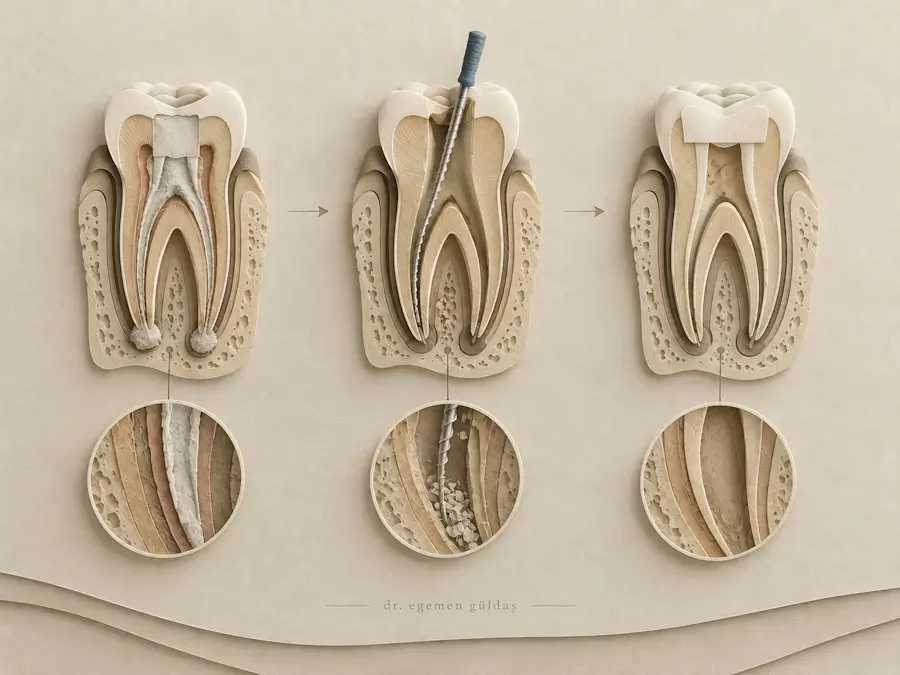
Root canal retreatment may be recommended when a tooth that has previously undergone root canal treatment does not heal as expected or develops a new infection. The procedure involves reassessing the tooth, identifying the possible cause of the problem and, where appropriate, removing the previous root canal filling so the canal system can be cleaned, disinfected and sealed again.
Dr. Egemen Güldaş, DDS, PhD, is an endodontist in Antalya who evaluates teeth with persistent or recurrent endodontic problems. Retreatment requires careful assessment of the existing root canal treatment, the tooth’s structural condition and the surrounding tissues.
For patients living in Antalya or travelling to Türkiye for dental care, the first step is to determine whether nonsurgical retreatment is appropriate, whether another endodontic procedure should be considered, or whether the tooth has a poor prognosis and alternative options need to be discussed.
What Is Root Canal Retreatment?
Root canal retreatment, also known as endodontic retreatment, is a procedure performed on a tooth that has already received root canal treatment.
Although the original treatment is intended to remove infection and seal the root canal system, some teeth may not heal completely or may become infected again. This can happen when bacteria remain in areas that were difficult to clean, a canal was not identified during the original procedure, or the tooth later loses its protective seal.
During nonsurgical retreatment, the existing root canal filling material is removed where necessary. The canal system is then reassessed, cleaned and disinfected before being filled and sealed again.
The purpose is to address the underlying cause of the problem and preserve the natural tooth when its condition allows. Retreatment is not appropriate for every previously treated tooth; the decision depends on the diagnosis, the technical feasibility of the procedure and the remaining tooth structure.
Why Might Root Canal Retreatment Be Necessary?
A tooth that has undergone root canal treatment may remain comfortable for years. In other cases, symptoms persist after treatment or develop months or years later. Some problems are discovered during a dental examination even when the patient has no pain.
Persistent or Recurrent Infection
Bacteria may remain within parts of the root canal system that were not adequately cleaned or disinfected. If infection persists around the root, further endodontic treatment may be considered after the cause has been assessed.
Missed Root Canals
Some teeth have complex internal anatomy, including additional canals that may be difficult to identify. If a canal was not located and treated during the original procedure, it may contribute to persistent inflammation or infection.
Incomplete Root Canal Treatment
If the root canals were not fully cleaned, shaped or sealed, the remaining spaces may allow infection to persist. Retreatment may provide an opportunity to address these areas, provided the canal system can be accessed safely.
Leakage Around a Filling or Crown
A damaged restoration, a loose crown or recurrent decay can compromise the seal protecting the treated tooth. Bacteria may then enter the tooth and contaminate the root canal system.
In these cases, both the endodontic condition and the integrity of the restoration need to be evaluated.
New Decay, Cracks or Structural Damage
A tooth that has already received root canal treatment can develop new decay or sustain a fracture. These problems may affect its prognosis and influence whether retreatment is worthwhile.
A vertical root fracture or extensive structural damage can make the tooth unsuitable for further endodontic treatment. Such findings must be distinguished from problems that can be corrected through retreatment.
What Are the Signs That a Previously Treated Tooth Needs Assessment?
Symptoms alone cannot establish whether retreatment is necessary. However, certain changes warrant a clinical examination.
Pain or Tenderness When Biting
Discomfort during chewing or when pressure is applied to the tooth may indicate inflammation around the root, a crack or another dental problem.
Swelling or a Gum Abscess
Swelling near a previously treated tooth, a recurring gum lesion or discharge may indicate persistent infection. These symptoms should be assessed promptly.
Persistent Discomfort After Treatment
If pain does not improve as expected after the original procedure, further investigation may be needed to determine whether the symptoms are related to the root canal system or another cause.
Changes on Dental X-Rays
An area of inflammation around the root may remain visible or develop after treatment. Comparing current images with previous radiographs can help determine whether the tissues are healing or whether the findings require further investigation.
No Symptoms but Evidence of Disease
A tooth may have persistent disease without causing noticeable pain. Routine clinical and radiographic assessments can identify changes that would otherwise remain undetected.
How Is Root Canal Retreatment Performed?
The procedure depends on the original treatment, the anatomy of the tooth, the type of existing restoration and the cause of the problem.
1. Examination and Diagnosis
The tooth is assessed through a clinical examination, a review of symptoms and appropriate dental imaging. Previous radiographs and treatment records, when available, may help clarify the history of the case.
The assessment considers the condition of the tissues around the root, the quality of the existing root canal filling, possible missed canals, cracks and the amount of remaining tooth structure.
Additional imaging, including three-dimensional imaging when clinically justified, may be considered if conventional radiographs do not provide sufficient information.
2. Access to the Root Canal System
The existing restoration may need to be accessed or partially removed to reach the root canals. In some cases, a crown, post or core must be removed. The need for this step depends on the design and condition of the restoration and the access required for treatment.
The approach is selected with consideration for preserving as much sound tooth structure as possible.
3. Removal of the Previous Root Canal Filling
The existing filling material is removed from the root canals as required. This allows the canal system to be examined and provides access to areas that may not have been adequately treated during the original procedure.
Previously placed posts, obstructions, calcified canals or separated instruments can make this stage more complex. Their management depends on the individual anatomy and the associated risks.
4. Identification of the Underlying Problem
Once access has been established, the canal system is examined for possible missed anatomy, residual material, inadequate treatment or other correctable factors.
Identifying the likely cause is essential because repeating the original procedure without addressing the underlying problem may not resolve the condition.
5. Cleaning and Disinfection
The accessible root canals are cleaned and disinfected using appropriate instruments and irrigation techniques. The method is adapted to the canal anatomy and the condition of the tooth.
The aim is to reduce microbial contamination and prepare the canal system for a new root canal filling.
6. Root Canal Filling and Sealing
After the canals have been appropriately prepared, they are filled and sealed. Depending on the findings and the treatment plan, a temporary restoration may be placed before the definitive restoration is completed.
7. Final Restoration and Follow-Up
The tooth is assessed for a suitable permanent restoration. Depending on the remaining tooth structure and functional demands, this may involve a filling, a crown or another restorative procedure.
Follow-up examinations and radiographs may be recommended to assess healing around the root. The timing of these reviews depends on the clinical findings.
Why Is an Endodontist’s Assessment Important in Retreatment?
Retreatment can be more technically demanding than initial root canal treatment because the tooth has already undergone a procedure and may contain existing filling materials, posts, calcifications or other obstructions.
Dr. Egemen Güldaş, DDS, PhD, focuses on the diagnosis and treatment of conditions affecting the dental pulp and tissues surrounding the roots. An endodontic assessment examines the reasons for persistent or recurrent disease and considers the available treatment options.
The evaluation may involve:
- Reviewing the quality and limitations of the previous root canal treatment.
- Assessing root canal anatomy and the possibility of untreated canals.
- Identifying technical obstacles that may affect access or cleaning.
- Evaluating cracks, fractures, decay and the condition of existing restorations.
- Determining whether nonsurgical retreatment, endodontic surgery or another option is appropriate.
The objective is to make a treatment decision based on the individual tooth rather than assuming that every previously treated tooth requires the same procedure.
Can a Tooth Be Saved With Root Canal Retreatment?
Retreatment may allow a tooth to be retained when the cause of persistent disease can be addressed and the tooth remains structurally suitable for restoration. However, the outcome depends on several clinical factors.
The prognosis may be influenced by the extent of infection, the complexity of the root canal anatomy, the presence of cracks or fractures, the amount of remaining tooth structure and the quality of the final restoration.
If nonsurgical retreatment is not feasible or is unlikely to resolve the problem, endodontic surgery may be considered in selected cases. If the tooth has a fracture or cannot be predictably restored, extraction and replacement options may need to be discussed.
A clinical assessment helps explain the potential benefits, limitations and risks of each option before treatment begins.
Root Canal Retreatment for International Patients in Antalya
Patients travelling to Antalya for dental care may have limited time available for assessment, treatment and restorative work. Retreatment planning should therefore consider both the clinical requirements and the patient’s travel schedule.
Some cases may be completed within a limited number of appointments, while others require additional visits because of infection, complex anatomy, technical difficulties or the need for a new restoration.
Before travel, patients may share previous dental radiographs, treatment notes and information about existing crowns or posts, if available. These records can support the initial review but do not replace a clinical examination.
A treatment plan should clarify:
- Whether retreatment appears clinically appropriate.
- Whether additional diagnostic imaging may be required.
- The likely number and sequence of appointments.
- Whether a temporary restoration or new crown may be needed.
- Whether follow-up should take place after the patient returns home.
Treatment should not be rushed solely to fit a travel itinerary. The appropriate schedule depends on the findings and the steps required for safe treatment.
Recovery After Root Canal Retreatment
Some tenderness around the treated tooth may occur after retreatment, particularly when inflammation was present before the procedure. Symptoms should generally improve rather than become progressively worse.
Patients should follow the aftercare instructions provided and avoid heavy biting on the tooth until the recommended restoration has been completed.
Contact the treating dentist if pain increases, swelling develops or symptoms do not improve as expected. Facial swelling accompanied by difficulty swallowing or breathing requires emergency medical care.
Follow-up is important because the absence of pain does not, by itself, confirm that the tissues around the root have healed. Clinical examination and appropriate radiographs may be needed to evaluate the response to treatment.
Frequently Asked Questions About Root Canal Retreatment
Is root canal retreatment painful?
Local anaesthesia is used when appropriate to keep the procedure comfortable. Some tenderness may occur afterwards, depending on the condition of the tooth and surrounding tissues. The experience varies between patients.
Does a previously treated tooth always need retreatment if it hurts?
No. Pain can have several causes, including a crack, a problem with the bite, periodontal disease or inflammation around the root. Examination and appropriate diagnostic tests are needed to determine the cause before retreatment is recommended.
Can root canal retreatment be performed through an existing crown?
In some cases, access can be made through an existing crown. In others, the crown or an underlying post may need to be removed or replaced. The decision depends on the restoration’s condition, the access required and the risk of damaging the tooth or restoration.
What if retreatment is not possible?
If nonsurgical retreatment cannot adequately address the problem, endodontic surgery may be considered in selected cases. When the tooth cannot be predictably preserved, extraction and replacement options may be discussed.
How many appointments are needed?
The number of appointments depends on the complexity of the case, the presence of infection, access difficulties and the restorative work required. The schedule can be discussed after the initial assessment, although it may need to change according to clinical findings.
Can I have root canal retreatment during my visit to Antalya?
It may be possible, but this depends on the condition of the tooth, the complexity of the procedure and the time available. Patients should allow for the possibility of additional appointments and follow-up, rather than assuming treatment will be completed in a single visit.
Clinical Assessment for Root Canal Retreatment
If a tooth that has previously undergone root canal treatment is painful, swollen or showing signs of persistent infection, an endodontic assessment can help establish the cause and identify appropriate treatment options.
Dr. Egemen Güldaş, DDS, PhD, provides endodontic assessment and treatment in Antalya. The decision to perform retreatment is based on the condition of the tooth, the findings of the examination and the feasibility of preserving and restoring it.